Industrial Mixing Equipment: Types, Specs and Practical Industrial Uses
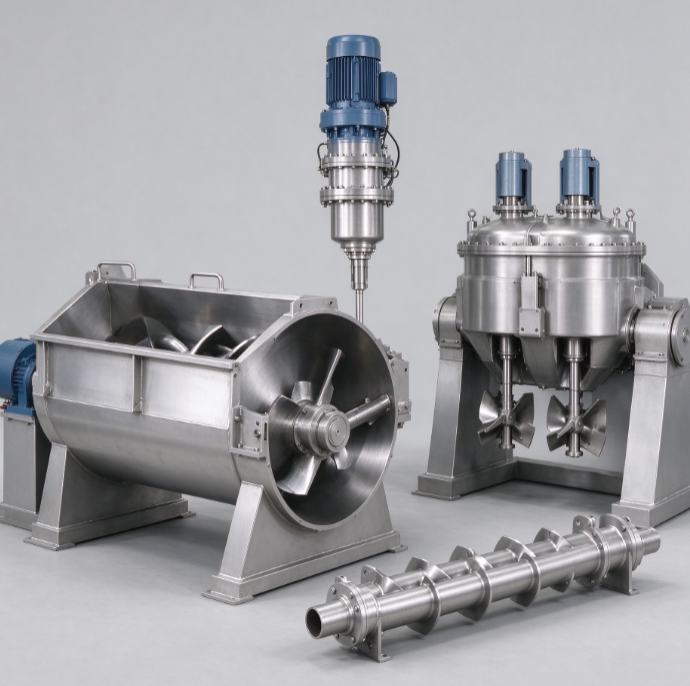
Table of Contents
1. Basic Overview of Industrial Mixing Equipment
2. Common Types of Industrial Mixing Equipment
3. Mixer Performance Parameter Comparison
4. Core Functional Features
5. Typical Industrial Application Scenarios
6. Frequently Asked Questions
1. Basic Overview of Industrial Mixing Equipment
Industrial mixing equipment are mechanical devices. It blend solid, liquid and viscous materials in industrial production lines.
These industrial mixers replace manual mixing work. It ensure uniform material composition and stable product quality.
Different mixing machines adapt different material viscosity and batch sizes. It cover most chemical, food and pharmaceutical production needs.
Standard industrial mixing equipment improve production efficiency. It reduce material waste in batch processing.
2. Common Types of Industrial Mixing Equipment
2.1 Ribbon Blender
Ribbon blender is the most widely used powder mixing equipment. It adopt horizontal spiral ribbon stirring structure.
It handle dry powder and granular materials efficiently. It suit large-batch uniform mixing tasks.
This machine has simple structure and low maintenance cost. It popular in daily industrial production.
2.2 High Shear Mixer
High shear mixer use rotor-stator structure. It generate strong shear force during operation.
It break material agglomeration and complete emulsification and dispersion. It work well for liquid and paste materials.
High shear mixing equipment fit high-precision homogenization production requirements.
2.3 Paddle Mixer
Double shaft paddle mixer rely on rotating paddles for material convection mixing.
It have fast mixing speed and high homogeneity. It process both powder and small particle materials.
This equipment has small mixing dead zone. It improve overall mixing uniformity.
2.4 Static Mixer
Static mixer have no moving parts inside. It use fixed internal components to split and recombine fluid materials.
It need no motor drive. It save energy for continuous fluid mixing processes.
3. Mixer Performance Parameter Comparison
Different industrial mixing equipment have obvious gaps in mixing speed, uniformity and applicable viscosity. The table below display verified professional test data from industrial equipment industry standards.
Mixer Type | Single Batch Time | Mixing Homogeneity (CV Value) | Max Processing Viscosity | Best Suitable Material |
Ribbon Blender | 3–6 minutes | 7–10% | 10,000 cP | Dry powder, granular materials |
Double Shaft Paddle Mixer | 30–120 seconds | ≤5% | 20,000 cP | Mixed powder and fine particles |
High Shear Mixer | 2–5 minutes | ≤3% | 100,000 cP | Liquid, emulsion, viscous paste |
Static Mixer | Continuous flow | ≤4% | 50,000 cP | Low-viscosity fluid materials |
Double shaft paddle mixer have the fastest batch processing speed. It greatly improve production output for large-scale factories.
High shear mixer own the best mixing uniformity. It meet high-standard emulsification and dispersion production demands.
Ribbon blender have the lowest equipment cost. It is the most cost-effective choice for ordinary powder mixing.
4. Core Functional Features
4.1 High Mixing Uniformity
Professional industrial mixing equipment eliminate material uneven distribution.
It make raw material composition consistent for every finished batch.
4.2 Wide Material Adaptability
Different types of industrial mixers cover powder, liquid and high-viscosity paste materials.
It support diversified production formulas in different industries.
4.3 Stable Operational Safety
Qualified industrial mixing equipment adopt sealed structural design.
It avoid material leakage and dust pollution during mixing process.
5. Typical Industrial Application Scenarios
5.1 Chemical Industry
Industrial mixing equipment mix chemical powders and liquid reagents.
High shear mixer complete emulsification of chemical coating materials.
5.2 Food and Beverage Production
Sanitary-grade ribbon blender and paddle mixer process food raw materials.
It ensure food formula uniformity and meet food safety standards.
5.3 Pharmaceutical and Cosmetic Industry
High-precision industrial mixers mix pharmaceutical powder and cosmetic paste.
Low mixing error guarantee product stability and safety in use.
6. Frequently Asked Questions
Q1: Which industrial mixing equipment suit dry powder mixing?
A1: Ribbon blender and double shaft paddle mixer are ideal for dry powder mixing. Paddle mixer provide faster speed and higher uniformity than traditional ribbon blender.
Q2: What is the advantage of high shear mixer?
A2: High shear mixer produce strong shear force. It solve material agglomeration problems, and achieve fine emulsification and homogenization for viscous liquid materials.
Q3: Is static mixing equipment energy-saving?
A3: Yes. Static mixer have no rotating parts and no motor power consumption. It is very suitable for long-term continuous fluid mixing production.
Q4: What mixing uniformity can standard industrial mixers reach?
A4: Ordinary mixing equipment keep CV value below 10%. High-precision industrial mixing equipment can control uniformity within 3% for high-end production needs.